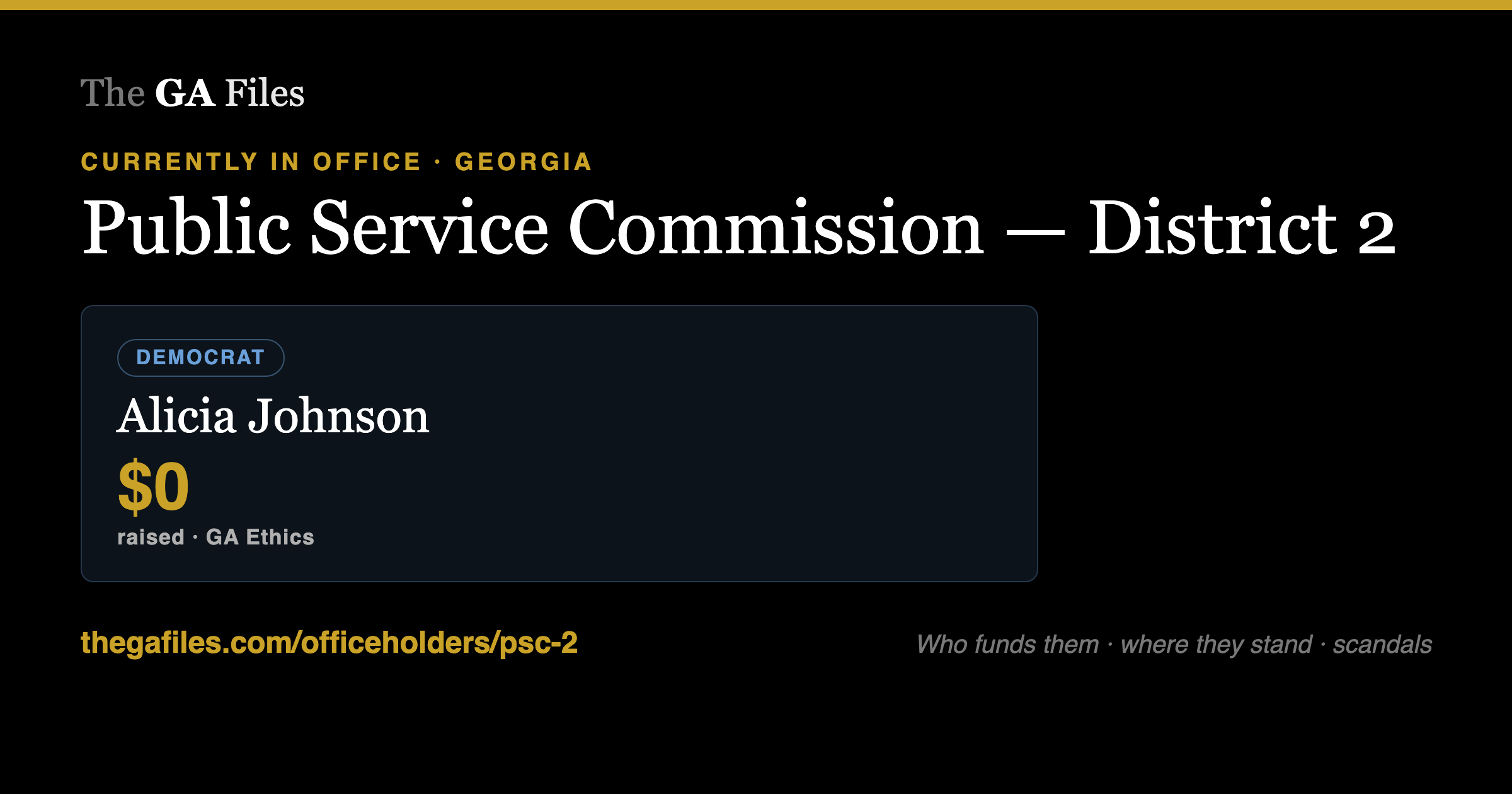
Dr. Alicia Johnson, a Savannah native with three decades in human services and nonprofit leadership, was elected to the Public Service Commission in November 2025 on an affordability platform, unseating longtime Republican Tim Echols. An Energy & Policy Institute analysis found she accepted no money from the regulated utilities she now oversees — her state campaign committee reports essentially no itemized contributions — while her opponent drew most of his funds from utility-affiliated donors.
Office & background
- PSC Commissioner, District 2 (2026–present)
- Executive Director, Step Up Savannah (anti-poverty nonprofit)
- Healthcare consultant / Medicaid program roles
Campaign finance — who funds them
$203 raised · $6,366 cash on hand (Friends to Elect Alicia Johnson)
No itemized contributions reported in the current filings yet.
Finance as of Aug 7, 2026 — latest GA Ethics filing (2026 Jul 31 CCDR).
Source: Georgia Government Transparency & Campaign Finance Commission (PeachFile)
Where they stand
Campaign position: argued data-center costs are being shifted onto residential customers and called for data centers to “pay their fair share” through community-benefit agreements, audits, and requirements that they supply their own solar and storage.
Source: AJC — meet the PSC candidates · The Current — Johnson, coastal PSC challengerCampaign position: ran directly against the rate increases, citing six hikes in roughly two years and accusing the commission of “rubber-stamping” Georgia Power’s requests rather than regulating.
Source: The Current — Johnson, coastal PSC challengerCampaign position: championed rooftop and community solar paired with battery storage and microgrids, and floated “power prescriptions” giving solar credits to medically fragile families.
Source: Ballotpedia — Alicia JohnsonCampaign position: opposed heavy fossil-fuel reliance — tying coal and gas to emissions and air pollution — and favored a shift toward renewables and regional coordination to cut the need for new plants.
Source: AJC — meet the PSC candidatesCampaign position: used Vogtle as her prime example of runaway utility costs, noting customers now pay $14+/month for reactors that came in years late and billions over budget, and arguing ratepayers shouldn’t keep absorbing overruns.
Source: The Current — Johnson, coastal PSC challengerCampaign position: criticized Georgia Power’s PSC-guaranteed 11.9% return on equity as too high and called for lowering it and for third-party cost audits. An Energy & Policy Institute review found she took zero dollars from regulated-utility interests.
Source: Energy & Policy Institute — PSC utility moneyCentral to her platform: pushed mandatory “energy burden” analyses in every rate case, targeted low-income and equity programs, and a rule that utilities exhaust financing before passing storm-recovery costs to customers.
Source: AJC — meet the PSC candidatesCampaign position: framed energy planning as needing to account for Georgia’s warming climate, tying fossil generation to air-pollution and public-health harms and positioning clean energy as both an affordability and environmental-equity solution.
Source: Ballotpedia — Alicia Johnson